Dunhuang · Gansu

Dunhuang Tours & Private Silk Road Trips 2026 | Mogao Caves, Crescent Lake, Singing Sand Dunes | JoyoTour

Dunhuang, Gansu — the last oasis before the desert, with 735 cave shrines at Mogao and a spring that has survived 2,000 years of sand. Three days covers it all.

The short version

Dunhuang is a Silk Road oasis in Gansu, western China, where 735 painted cave shrines at the Mogao Caves, a crescent-shaped lake that has held water for 2,000 years, and the tallest singing sand dunes on earth sit within 25 km of each other. Three days is the honest minimum: one full day for Mogao, one afternoon and sunset for Mingsha Shan and Crescent Lake, and one long day for the western line (Yumen Pass, Han Great Wall and the Yardang landforms). Come between May and October, book Mogao tickets online 7 days ahead, and expect a 1,139 m altitude — high enough for dry lips, nowhere near altitude sickness.

GansuProvince
May to October — September and October are the best of all; winter is cheap, empty and below -20°CBest months
DNHAirport
Connect via hubDaily intl. flights
Prefer it arranged for you? A desert oasis where Buddhist cave art survived a thousand years and a crescent lake refused to dry up. Dunhuang travel guide →

The place itself

What Dunhuang is actually like

Dunhuang is where the Gobi stops being empty. A green ribbon of poplars and melon fields sits in a basin ringed by the Qilian Mountains to the south and the Mingsha dunes to the south-east, and for 1,500 years this was the last Chinese town before the Taklamakan. Every caravan heading to Samarkand, Kashgar or Persia passed through here, and left something behind — a cave, a sutra, a name carved into a wall.

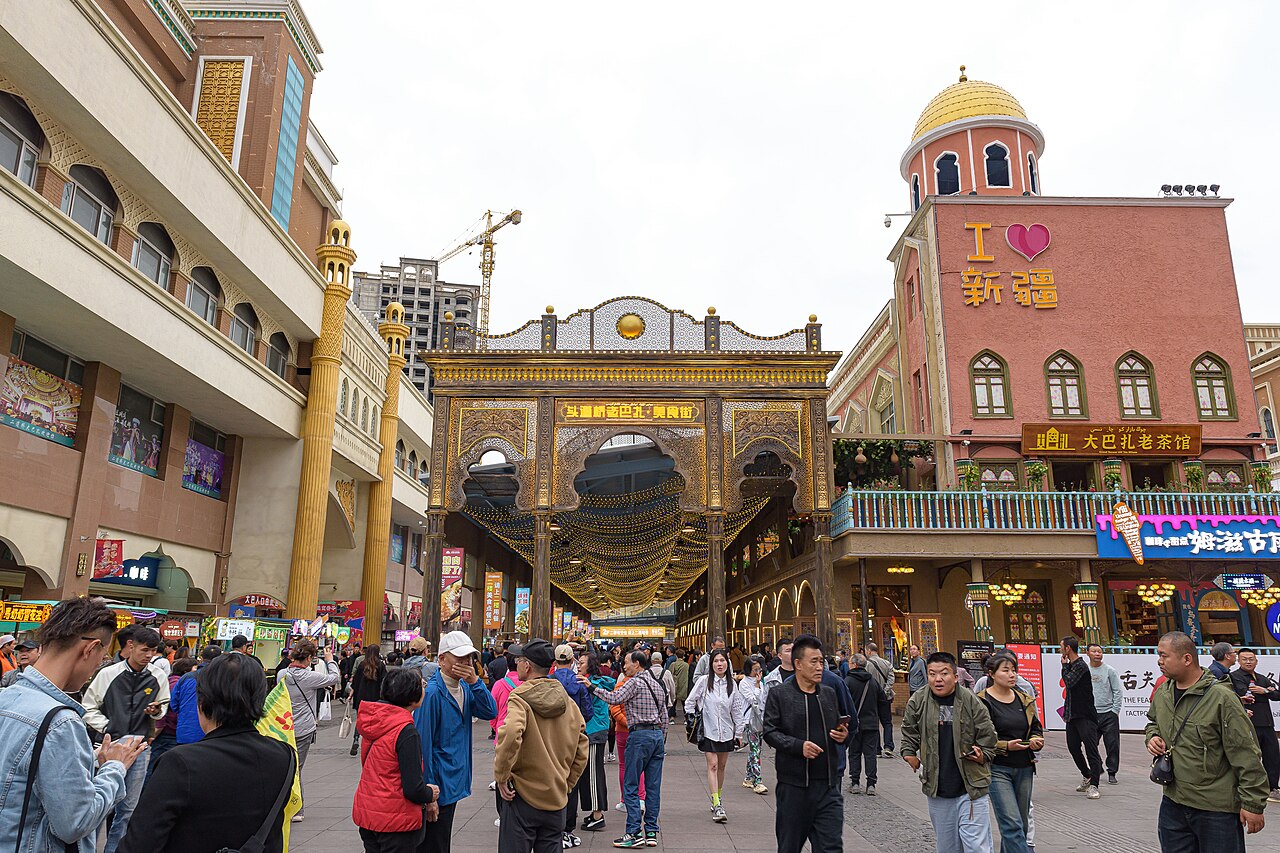
The town itself is small, walkable and unpretentious: one main street, a night market that smells of cumin and coal smoke, and a 25-metre statue of a flying apsara playing a pipa backwards. But the things that brought you here are all outside it. The Mogao Caves, cut into a 1.6-km cliff face 25 km south-east, hold the greatest surviving collection of Buddhist wall painting in the world. The sand dunes rise 250 m directly behind the town, and at their foot a spring the shape of a crescent moon has refused to dry up for two millennia.

You do not come to Dunhuang for comfort. You come because standing in a dark cave lit by a guide's torch, looking at a Bodhisattva painted in 650 AD by someone whose name is lost, is one of the few genuinely humbling experiences left in travel. Give it three days and it will stay with you for a decade.

75°E75°E90°E90°E105°E105°E120°E120°E135°E135°E20°N20°N30°N30°N40°N40°N50°N50°N ChangchunKashgar BeijingBeijingXi'anXi'anShanghaiShanghaiChengduChengduGuilinGuilinHangzhouHangzhouZhangjiajieZhangjiajieTibet · LhasaTibet · LhasaYunnan · KunmingYunnan · KunmingSichuan · ChengduSichuan · ChengduQinghai · XiningQinghai · XiningGansu · LanzhouGansu · LanzhouXinjiang · UrumqiXinjiang · UrumqiInner Mongolia · HohhotInner Mongolia · HohhotGuangzhouGuangzhouShenzhenShenzhenHarbinHarbinDalianDalianShenyangShenyangChangbai MountainChangbai MountainKunmingKunmingDaliDaliShuheShuheLijiangLijiangXiamenXiamenGulangyuGulangyuFuzhouFuzhouLugu LakeLugu LakeXishuangbanna · JinghongXishuangbanna · JinghongShangri-LaShangri-LaNanchangNanchangHefeiHefeiHongcunHongcunWuhanWuhanChangshaChangshaFenghuang Ancient TownFenghuang Ancient TownLushanLushanWuyuanWuyuanMount Heng (Hengshan, Hunan)Mount Heng (Hengshan, Hunan)HuangshanHuangshanWudang MountainWudang MountainLuoyangLuoyangYuntai MountainYuntai MountainRizhaoRizhaoYantaiYantaiLianyungangLianyungangSanqing MountainSanqing MountainTianjinTianjinDatongDatongTaiyuanTaiyuanPingyaoPingyaoWutai MountainWutai MountainHulunbuir · HailarHulunbuir · HailarThe Forbidden CityThe Forbidden CitySanyaSanyaHaikouHaikouBeihaiBeihaiNanningNanningGuangxi · NanningGuangxi · NanningHuizhouHuizhouZhuhaiZhuhaiWuyi MountainWuyi MountainBeidaiheBeidaiheShanhaiguanShanhaiguanBaiyangdianBaiyangdianQinhuangdaoQinhuangdaoYesanpoYesanpoJiuzhaigouJiuzhaigouMount SiguniangMount SiguniangHailuogouHailuogouDaocheng YadingDaocheng YadingShunan Bamboo SeaShunan Bamboo SeaDujiangyanDujiangyanQingcheng MountainQingcheng MountainQingdaoQingdaoMount TaiMount TaiJinanJinanWeihaiWeihaiQufuQufuPenglaiPenglaiChangdaoChangdaoNanjingNanjingSuzhouSuzhouZhouzhuangZhouzhuangTongliTongliWuxiWuxiYangzhouYangzhouZhenjiangZhenjiangChangzhouChangzhouWuzhenWuzhenXitangXitangXixi WetlandXixi WetlandNingboNingboMount PutuoMount PutuoQiandao LakeQiandao LakeShaoxingShaoxingZhoushanZhoushanHengdianHengdianYandang MountainYandang MountainZhejiang · HangzhouZhejiang · HangzhouHong KongHong KongHong Kong Outlying IslandsHong Kong Outlying IslandsHong Kong ShoppingHong Kong ShoppingMacaoMacaoTaipeiTaipeiKaohsiungKaohsiungTaiwan · TaipeiTaiwan · TaipeiUrumqiUrumqiNorth Xinjiang · UrumqiNorth Xinjiang · UrumqiQinghai LakeQinghai LakeMount EmeiMount EmeiLanzhouLanzhouMount HuaMount HuaDunhuangDunhuangGannan · LanzhouGannan · LanzhouSichuan–Tibet Highway (G318) · Chengdu (CTU)Sichuan–Tibet Highway (G318) · Chengdu (CTU)KangdingKangdingLhasaLhasaNyingchiNyingchiNamtsoNamtsoChongqingChongqingQiandongnan · GuiyangQiandongnan · GuiyangLiboLiboGuiyangGuiyangZhenyuanZhenyuanHuangguoshuHuangguoshu
Destination — click to open the guide Province or autonomous region Provincial capital Major river

Pins are plotted from real latitude and longitude on a 5° graticule. This is a schematic orientation diagram, not a political map — no boundaries are drawn.

What not to miss — Dunhuang

01

Mogao Caves (莫高窟)

735 caves carved over 1,000 years from the 4th to the 14th century, holding 45,000 sq m of murals and 2,415 painted clay sculptures. You see 8 caves on the standard tour, shown by a state guide with a torch; the famous 96th-cave nine-storey pavilion houses a 35.5 m seated Buddha. Book online, bring no camera into the caves, and go in the morning when the east-facing entrances catch the sun.

02

Mingsha Shan & Crescent Lake (鸣沙山·月牙泉)

Sand dunes up to 250 m high rise straight out of town, and the sand genuinely booms when you slide down it. At their base, Crescent Lake has held fresh water for 2,000 years, fed by an underground aquifer. Ride a camel (CNY 100), sandboard down the slope, then climb the ridge for sunset over the whole basin.

03

Yumen Pass & Han Great Wall (玉门关·汉长城)

The 'Jade Gate' was the western frontier of Han China, and only a square earthen fort remains, standing alone on the gravel plain 90 km north-west of town. Two kilometres further on, a stretch of the Han-dynasty rammed-earth wall still stands 2,000 years after it was built. Come at golden hour — the emptiness is the point.

04

Yardang 'Ghost City' (雅丹魔鬼城)

160 km from town, wind has carved the soft lakebed clay into a fleet of natural sculptures — sphinxes, battleships, lions — spread over 400 sq km. The park shuttle stops at four viewpoints; stay for sunset if you can, when the yellow clay turns orange and the wind starts howling through the gullies and gives the place its name.

05

Western Thousand Buddha Caves (西千佛洞)

Sixteen caves cut into the cliff above the Dang River, 35 km south-west of town, older than or contemporary with Mogao. Only 9 are visitable, but groups are tiny, the guide has time to talk, and the Northern Wei painting in Cave 5 is superb. CNY 40, and you will often have it to yourself.

06

Shazhou Night Market (沙洲夜市)

Dunhuang's evening ritual: grilled lamb skewers, apricot juice, donkeys and hand-pulled yellow noodles, plus a whole lane of jade, night-glow cups and painted copies of Mogao murals. It runs from about 18:00 until past midnight on Yangguan East Road, and it is where locals actually eat.

Getting there and away

Most travellers fly into Dunhuang Mogao International (DNH), 15 km east of town, with daily flights to Lanzhou, Xi'an, Beijing, Urumqi and Chengdu. Bus 12 runs from the airport to Shazhou Market East Gate in the centre for CNY 3; a taxi is about CNY 50–60, and the airport shuttle to the Sun Hotel costs CNY 15. By train, Dunhuang Station is 13 km east of the centre with bus 12 (CNY 3) or a shared taxi (CNY 10 per seat) into town — many hostels and hotels offer free pick-up, so ask when you book. The alternative is Liuyuan Station, 130 km away on the main Lanzhou–Urumqi line, which has far more services; buses to Dunhuang cost CNY 30 and shared taxis CNY 40 per seat, but the last bus leaves around 19:00, so late arrivals should pre-book a car. Long-distance buses also connect Dunhuang to Jiayuguan, Lanzhou, Xining, Hami and Urumqi.

Inside Dunhuang, city buses are the cheapest option and there are only a handful of useful routes. Bus 3 goes to Mingsha Shan and Crescent Lake (CNY 1, 20 minutes, from the Pipa statue roundabout on Shazhou South Road). Bus 8 runs to the Mogao Caves (CNY 8, 30 minutes, departing from Dunhuang Hotel at Minshan South Road). Bus 12 links the city, bus station, train station and airport for CNY 3. Everything else needs wheels: taxis are a flat CNY 5 anywhere in the city, CNY 10 to Mingsha Shan and CNY 40 to Mogao (share for CNY 10 a head). For the western line — Yumen Pass, Han Great Wall, Yardang — there is no public transport beyond two daily tourist buses (CNY 40 to Yangguan, CNY 86 to Yardang, morning departure 07:30 and one afternoon run), so most visitors charter a car: roughly CNY 400 for four people, CNY 700 for six to eight, plus CNY 100 if you add Yangguan. Bicycles can be rented at four points along Minshan Road, which is a pleasant way to reach Mingsha Shan on a cool evening.
Best time to visit — Dunhuang

MonthWeatherCrowdsVerdict
January4°C / -4°C · dry, coldQuietAvoid
February6°C / -1°C · dry, coldVery busyAvoid
March14°C / 5°C · dry, coldModerateGood
April21°C / 12°C · clear and mildModerateBest
May27°C / 18°C · clear and mildBusyBest
June31°C / 23°C · hot, humidModerateOK
July32°C / 25°C · hot, humidBusyOK
August30°C / 24°C · hot, humidBusyOK
September26°C / 19°C · clear and mildModerateBest
October20°C / 12°C · clear and mildVery busyBest
November12°C / 4°C · dry, coldQuietGood
December5°C / -2°C · dry, coldQuietGood

How many days do you need?

Three days is the right number and matches what the local guides recommend. Day one is Mogao Caves in the morning (the caves face east and the light is best, plus you avoid the afternoon heat), then Mingsha Shan and Crescent Lake from about 17:00 for camel riding, sandboarding and sunset over the dunes, finishing at Shazhou Night Market. Day two is the western line — Dunhuang Old Town film set, West Thousand Buddha Caves, Yumen Pass, the Han Great Wall, and Yardang Ghost City at sunset — a long 10-hour day in a chartered car. Day three is the slow one: Dunhuang Museum (free, and it makes sense of everything you have seen), the White Horse Pagoda, Leiyin Temple, and a second, calmer sunset from the dunes if the sky is clear. Add a fourth day only if you want to see the Sanwei Mountains, the Western Jin tomb, or simply sit in a melon field and eat.

Plan these days properly

Frequently asked questions

Is Dunhuang worth visiting, and how many days do I need?

Yes — Dunhuang is one of the few places on the Silk Road where the history is still physically there, not just a plaque. Three days is the right amount: one day for the Mogao Caves, one afternoon and evening for Mingsha Shan and Crescent Lake, and one full day for the western line of Yumen Pass, the Han Great Wall and Yardang. Two days is possible if you skip the west entirely, but you would be missing the emptiness that makes Dunhuang feel like the edge of the world.

When is the best time to visit Dunhuang?

May to October, with September and October the best of all — warm days, cool nights and clear skies. July and August are hot (up to 38°C) and busy, so go early in the morning and late in the afternoon. November to April is cold (down to -28°C), windy and dusty, but it is also cheap: most tickets halve in price and you will have the caves almost to yourself.

How do I book Mogao Caves tickets, and how far ahead?

Book online through the official Mogao Caves WeChat account or website at least 7 days ahead in peak season (May–October), because daily visitor numbers are strictly capped. Peak-season tickets are CNY 160 (CNY 180 for foreign passports), off-season CNY 80, students half price. Bring your passport — it is checked against the booking — and note that the ticket office stops selling at 16:00 in peak season and 15:00 in low season.

Can I visit Mogao Caves without a tour, and is photography allowed?

You visit only as part of a guided group — this is compulsory and included in the ticket, not optional. A state guide takes about 20–25 people through 8 caves with a torch and a headset. Photography and video are completely forbidden inside the caves, and tripods, selfie sticks and large bags must be left at the entrance; the light from a single camera flash damages 1,000-year-old pigment, and the rule is enforced.

Morning or afternoon for Mingsha Shan and Crescent Lake?

Both work, but they feel different. Sunrise from the ridge is spectacular and the sand is cool and empty — though you must be at the gate around 05:30 in summer. Most people go in the late afternoon, entering around 17:00, riding a camel, climbing to the ridge and staying for sunset, when the dunes turn from yellow to deep orange. The ticket is CNY 120 and the gate is open all day; avoid 11:00–15:00 in July and August, when the sand is genuinely painful to walk on.

Will I get altitude sickness in Dunhuang?

No. Dunhuang sits at 1,139 m, which is well below the 3,000 m threshold where altitude sickness typically begins. You may notice dry air, chapped lips and a lot of thirst, but no breathlessness. The real hazards are heat, sunburn and dehydration — drink more water than you think you need and reapply sunscreen every two hours, especially on the dunes where reflection doubles the UV.

Tell us your dates.
We'll do the rest.

Free itinerary design, a revised plan within one working day, and nothing charged until you approve the final version.

  • Free itinerary planning by a destination specialist
  • A revised draft within one working day
  • Nothing is charged until you approve the final version.

No spam. No sales calls. Just a real itinerary from a real person.