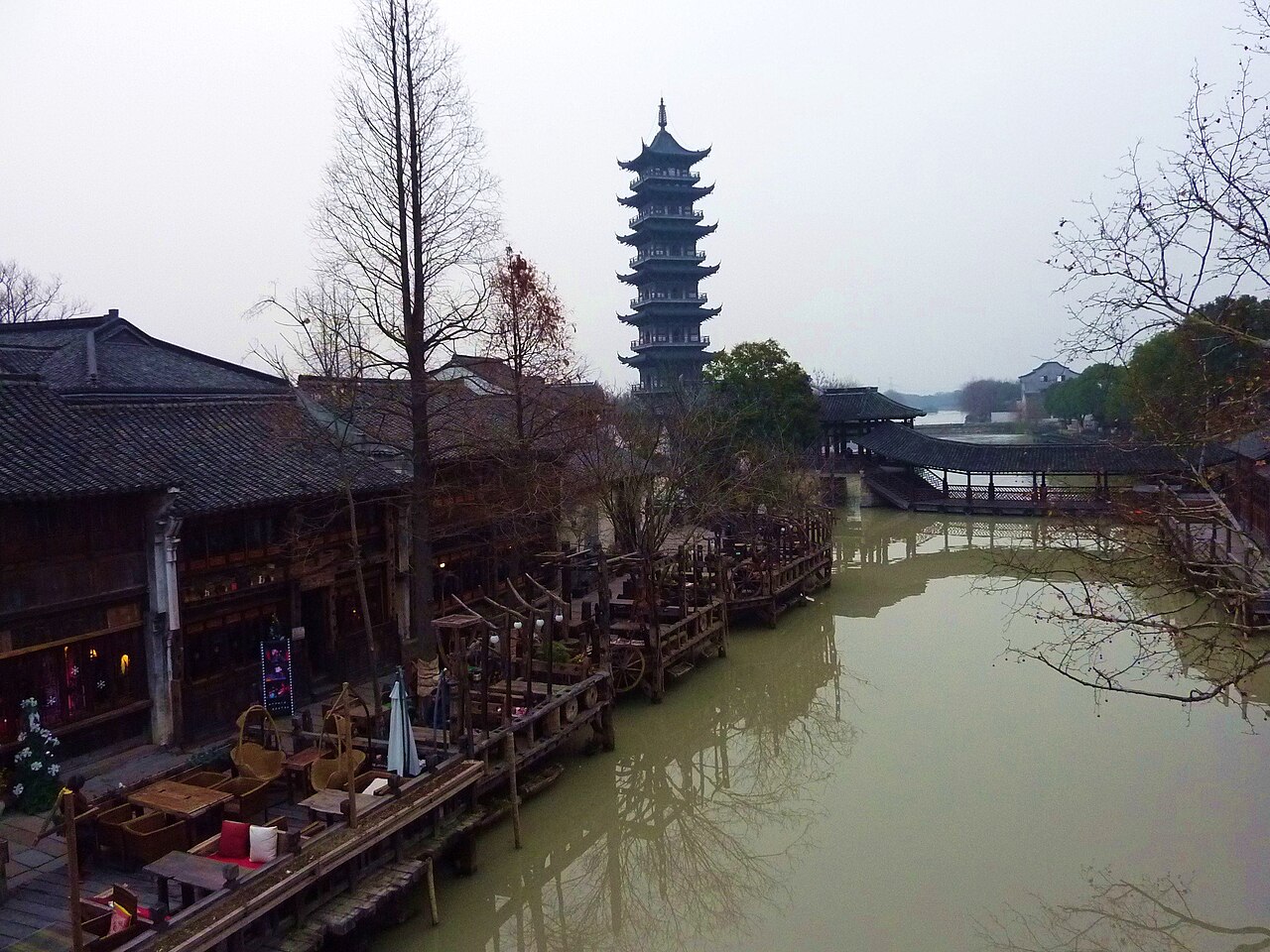
Hengdian is not a city that grew into a film studio; it is a film studio the size of a town. Since 1996 the Hengdian Group has poured billions of yuan into turning a patch of Dongyang countryside into the largest backlot in Asia, and the American trade press gave it the name that stuck — China's Hollywood. There are now more than a dozen sets spread across some 10 sq km, each one a full-scale reconstruction of a different century.
The sets are the point, and they are gloriously unashamed of being fake. There is a Qin palace with 27 halls and a 2,289 m wall, built for Chen Kaige's 'The Emperor and the Assassin' and since used for 'Hero' and 'The Mummy: Tomb of the Dragon Emperor'. There is a 1:1 copy of the Forbidden City that has stood in for the real thing in a hundred palace dramas. There is a 19th-century Guangzhou and Hong Kong street built for Xie Jin's 'The Opium War', and a Song-dynasty river town lifted straight out of a classical painting.
What keeps it from being a waxworks is the working industry around it. Some 7,500 registered extras live here, more than 600 films and 3,000-odd TV episodes have been shot in town, and the studios say they welcome eight million visitors a year. You will see costumed actors eating lunch, prop carts rattling down back streets and crews filming in the open — the behind-the-scenes spectacle is half the ticket.
It is an easy place to bolt onto a Zhejiang trip: Yiwu is 36 km away and has the nearest airport, Hangzhou is 160 km north with shuttle coaches, and the sets are joined by a ¥1 tourist bus looping every fifteen minutes. Give it two days — one for the historical sets, one for Dream Valley after dark.