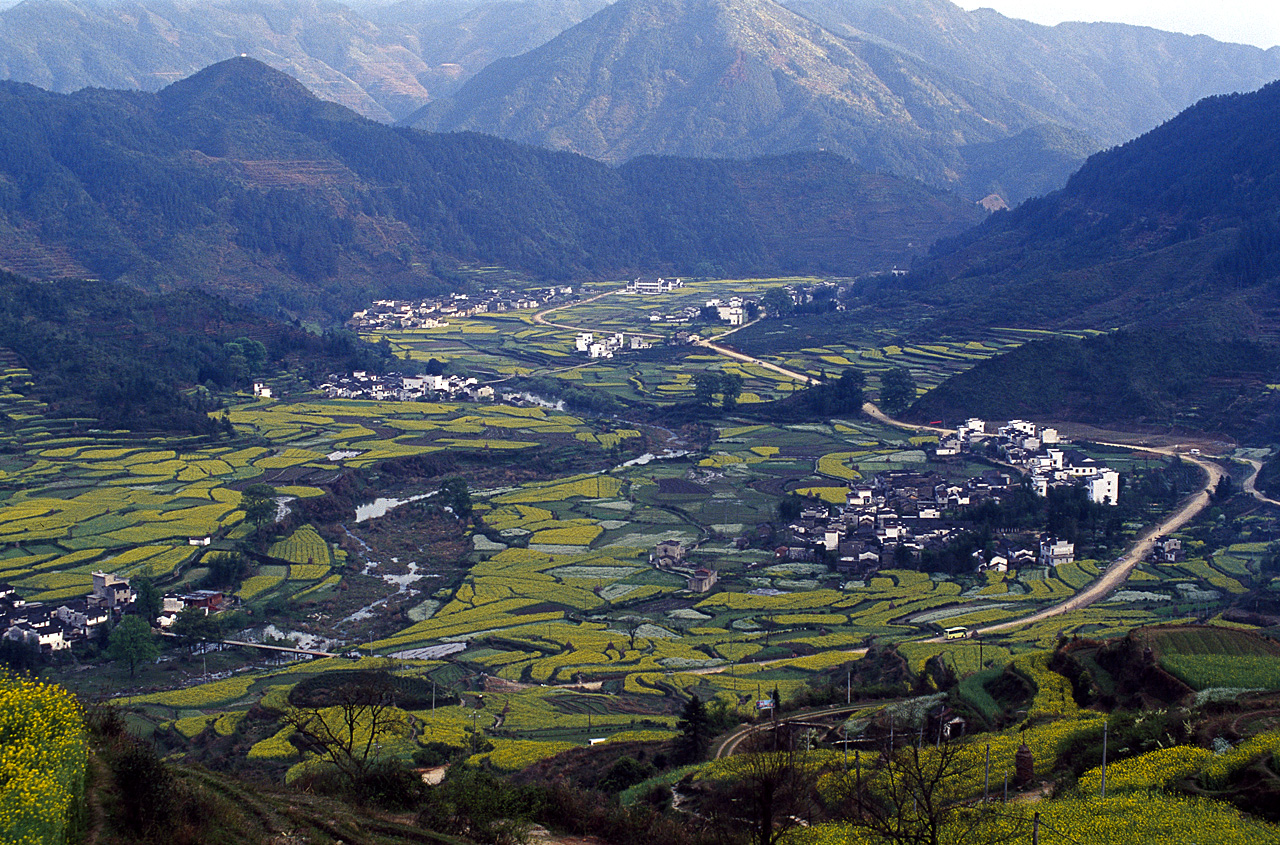
Hongcun is the sort of village that ends up on banknotes and film sets, and it has earned it. A cluster of white-walled, black-tiled Hui houses, set against green hills and reflected in still water, it has been called 'the village inside a Chinese painting' for so long that the phrase has worn thin — until you stand at Moon Pond at dawn and see it is simply true.
What makes Hongcun more than a pretty backdrop is its plan. In the twelfth century the village's founders, drawing on feng shui, re-imagined the whole settlement as an ox: the hills as the head, two old trees as the horns, a winding channel of water as the intestines, Moon Pond as the stomach and South Lake as the belly. Every house was joined to the water, and still is.
That water is the reason to slow down. It cools the lanes in summer, supplies the kitchens and the washing stones, and turns each alley into a corridor of reflections. It also explains why Hongcun, alone among the Hui villages, feels less like a museum and more like somewhere that is still lived in.
The catch is that everyone knows. Hongcun is a top-tier sight and, from mid-morning, the lanes fill with tour groups and art students with sketchpads. The village is compact, so the fix is easy: come early, leave late, or sleep over. One night inside the walls buys you both the dawn and the dusk, when the coaches have gone and Hongcun goes quiet again.