Guilin and the Li River
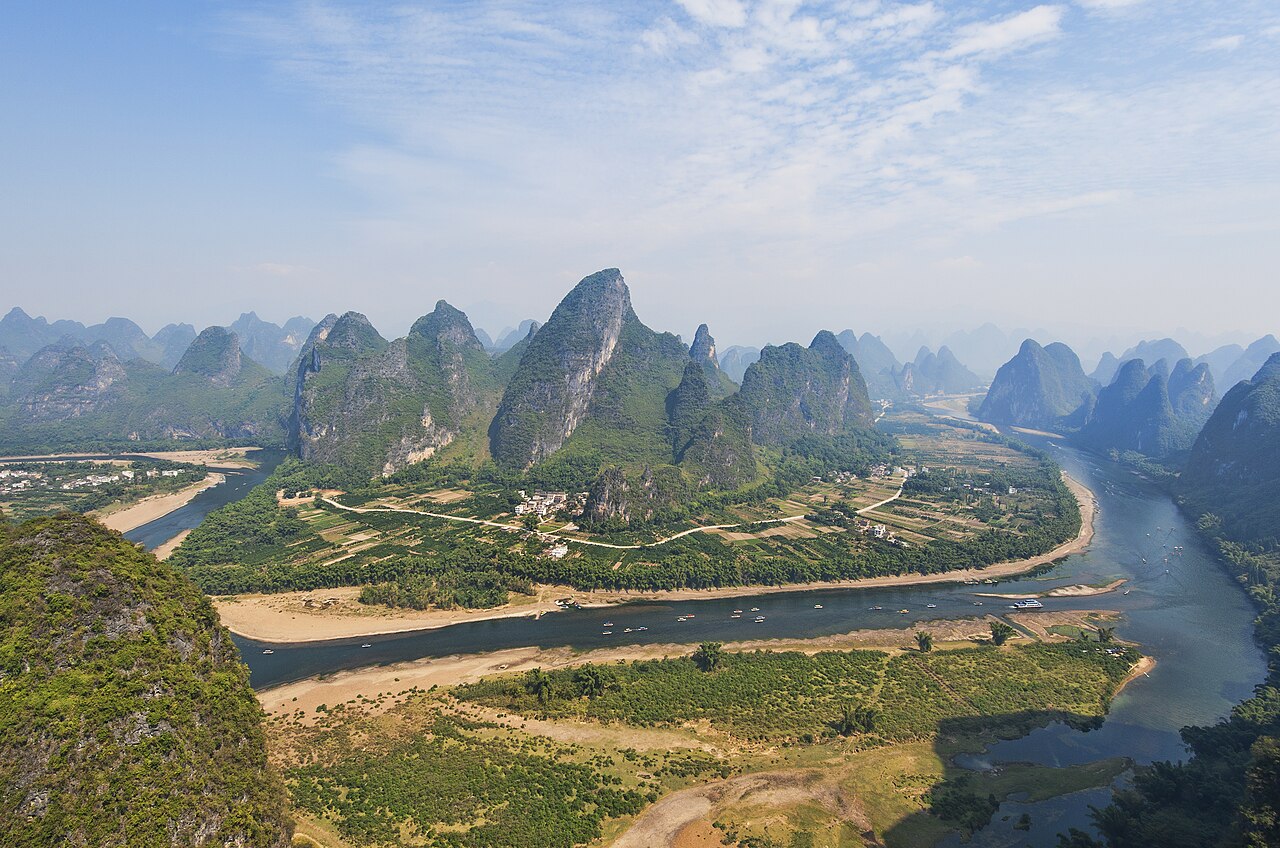
The karst heartland: the Li River between Yangdi and Xingping, the 20-yuan-note view, and a town built around two rivers and four lakes. Give it 3 days at least, and use Guilin as your northern base.
Guangxi · Guangxi
Guangxi is China's karst-and-coast province: Guilin and Yangshuo, the Longji terraces, Detian Falls on the Vietnam border and the Beibu Gulf. Private Guangxi tours from US$149 a day.
The short version
The place itself
Guangxi has a reputation problem in the best sense: everyone knows a fragment of it and almost no one knows the whole. The postcard in most people's heads is Guilin — the karst peaks and the Li River, the 20-yuan note scenery at Yangshuo. But the province is twice that size and far more varied, running from limestone towers in the subtropical north to a long, warm Gulf of Tonkin coast in the south, with a 1,000 km land border against Vietnam stitched along the bottom.
It is also the most diverse corner of southern China. Guangxi is the Zhuang Autonomous Region, and the Zhuang — at around 16 million, China's largest ethnic minority — share it with the Yao, Miao, Dong and others. In the north-east around Sanjiang you find Dong drum towers and wind-and-rain bridges; in the far north-west, the Yao terraces at Longji climb the hillsides in green ribbons.
The province is best read as a loop rather than a single stop. Come in through Guilin, move south through Liuzhou to Nanning, swing west to the Detian Falls and the border towns, then finish at the sea in Beihai. The trains carry you between the big cities; the landscapes in between — the terraces, the canyons, the border markets — are where the province actually lives.
Go April to May or September to November for dry, clear weather and terrace water or ripe rice depending on the season. July and August bring the heat, the rain and, on the coast, the tail of the typhoon season — cheap, but you plan around the sky.
Pins are plotted from real latitude and longitude on a 5° graticule. This is a schematic orientation diagram, not a political map — no boundaries are drawn.
The karst heartland: the Li River between Yangdi and Xingping, the 20-yuan-note view, and a town built around two rivers and four lakes. Give it 3 days at least, and use Guilin as your northern base.
The village that made the scenery famous — bamboo rafts on the Yulong, bicycles through the Ten-Mile Gallery, and rock climbing on limestone that draws climbers from all over Asia. Sleep in Yangshuo, not Guilin, for the quiet mornings.
The 'Dragon's Backbone' terraces at Longsheng, cut into the hillsides over 700 years. Two villages, Ping'an and the bigger Jinkeng (Dazhai), both with guesthouses whose windows open straight onto the steps; the water season and the golden autumn are the two peaks.
Asia's largest transnational waterfall, straddling China and Vietnam near Daxin, plus the cliff paintings at Huashan and the old pass at Youyiguan (Friendship Pass). This is the wild, less-visited south-west of the province.
Drum towers, covered wind-and-rain bridges and a whole way of life around Sanjiang and Chengyang in the north-east. It is the least touristed of Guangxi's big set-pieces and one of the most rewarding.
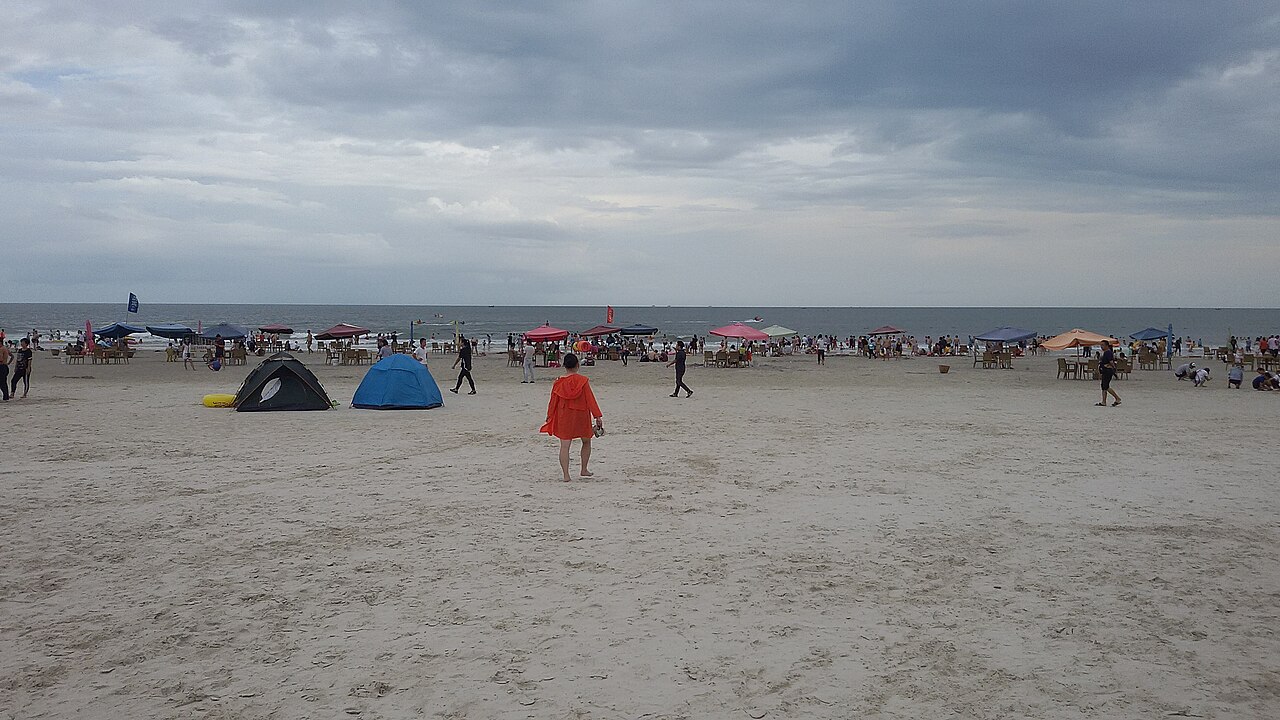
The 24 km Silver Beach and the volcanic island of Weizhou, with its coral, crater park and French coral-built church, off the Gulf of Tonkin. The south coast is a different Guangxi entirely — warm, flat and salt-aired.
Nanning Wuxu International Airport (NNG) is the region's main gateway, 32 km south-west of the capital, with dense domestic service and direct routes to ASEAN cities. Guilin Liangjiang (KWL) is the northern gateway and closer to the karst, with its own international flights. From either, high-speed rail is the way to move on: Nanning to Guilin takes about 2h 30m, Nanning to Beihai about 3h, and the network reaches Liuzhou and the coast.
For the border and the mountains, the train gives way to the road. Detian Falls is about 4 hours from Nanning by road; the Longji terraces are about 2 hours from Guilin, then a village bus or a walk; Sanjiang has its own high-speed station on the Guiyang–Guangzhou line, which makes the Dong villages far easier than they used to be. Buses are cheap and frequent between the towns, and a private car is the least stressful way to reach the far border.
| Month | Weather | Crowds | Verdict |
|---|---|---|---|
| January | 12°C / 4°C · cool, damp | Quiet | Good |
| February | 14°C / 6°C · cool, damp | Very busy | Good |
| March | 18°C / 10°C · clear and mild | Moderate | Best |
| April | 24°C / 16°C · clear and mild | Moderate | Best |
| May | 28°C / 21°C · cool, damp | Busy | OK |
| June | 32°C / 25°C · very hot, humid | Moderate | OK |
| July | 35°C / 28°C · cool, damp | Busy | Avoid |
| August | 34°C / 27°C · cool, damp | Busy | Avoid |
| September | 29°C / 23°C · very hot, humid | Moderate | OK |
| October | 24°C / 17°C · clear and mild | Very busy | Best |
| November | 18°C / 11°C · clear and mild | Quiet | Best |
| December | 13°C / 6°C · cool, damp | Quiet | Good |
Eight to ten days is the honest range. The classic loop — Guilin, the Li River and Yangshuo, the Longji terraces, then south to Nanning, out to Detian Falls and the border, and finally the sea at Beihai — needs about nine days without rushing. Five days buys you either the north (Guilin, Yangshuo, Longji) or the south (Nanning, Detian, Beihai) done properly, not both. Add days for Sanjiang's Dong villages and for an overnight on Weizhou Island.
Plan these days properly Transport
China's High-Speed Rail: How to Book, What It Costs, How Fast It Goes
The fastest way to cross China is also the most pleasant. Here is how to book a ticket with a foreign passport, what the three classes actually give you, and how to survive a Chinese station at rush hour.
9 min read
Transport
China's High-Speed Rail: How to Book, What It Costs, How Fast It Goes
The fastest way to cross China is also the most pleasant. Here is how to book a ticket with a foreign passport, what the three classes actually give you, and how to survive a Chinese station at rush hour.
9 min read
 Planning
Best Time to Visit China: Month by Month, Region by Region
China is the size of Europe, so 'the best month' depends on where you stand. Here is the month-by-month answer for the north, the Yangtze valley, the south and the plateau.
8 min read
Planning
Best Time to Visit China: Month by Month, Region by Region
China is the size of Europe, so 'the best month' depends on where you stand. Here is the month-by-month answer for the north, the Yangtze valley, the south and the plateau.
8 min read
 Food
Chinese Food Culture: Eight Cuisines, One Table
There is no such thing as Chinese food. There is Cantonese, Sichuan, Hunan, Jiangsu, Zhejiang, Fujian, Anhui and Shandong — and knowing which one you are eating changes everything.
8 min read
Food
Chinese Food Culture: Eight Cuisines, One Table
There is no such thing as Chinese food. There is Cantonese, Sichuan, Hunan, Jiangsu, Zhejiang, Fujian, Anhui and Shandong — and knowing which one you are eating changes everything.
8 min read
 Peoples
China's Ethnic Minorities: 55 Groups, and Where to Meet Them
Roughly one in twelve people in China is not Han. Their languages, crafts and festivals are the least visited part of the country, and in several regions the most rewarding.
8 min read
Guilin
Guangxi Zhuang Autonomous Region · 2 tours
Guilin is in the Guangxi Zhuang Autonomous Region, and it gives you the landscape Chinese painting was invented to describe: limestone karst peaks ris
Peoples
China's Ethnic Minorities: 55 Groups, and Where to Meet Them
Roughly one in twelve people in China is not Han. Their languages, crafts and festivals are the least visited part of the country, and in several regions the most rewarding.
8 min read
Guilin
Guangxi Zhuang Autonomous Region · 2 tours
Guilin is in the Guangxi Zhuang Autonomous Region, and it gives you the landscape Chinese painting was invented to describe: limestone karst peaks ris
 Beihai
Guangxi · 4 tours
Beihai is Guangxi's Gulf of Tonkin coast, 200 km south of Nanning, and it pairs one of China's best beaches with a volcanic island worth a night of it
Beihai
Guangxi · 4 tours
Beihai is Guangxi's Gulf of Tonkin coast, 200 km south of Nanning, and it pairs one of China's best beaches with a volcanic island worth a night of it
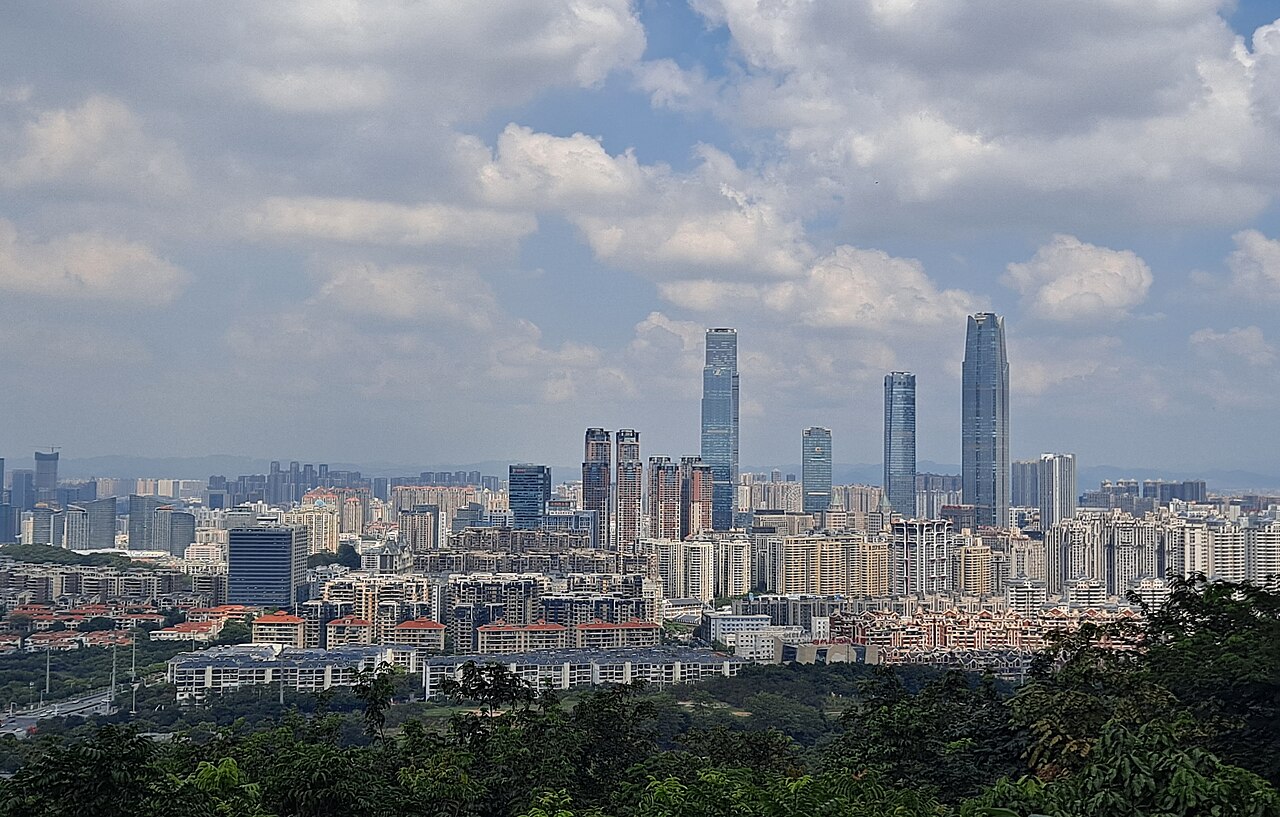 Nanning
Guangxi · 4 tours
Nanning is the capital of Guangxi and the gateway most travellers pass through on the way to somewhere else — Detian Falls, Beihai, or Vietnam. It des
Nanning
Guangxi · 4 tours
Nanning is the capital of Guangxi and the gateway most travellers pass through on the way to somewhere else — Detian Falls, Beihai, or Vietnam. It des
Allow 8 to 10 days to see the province properly — Guilin and Yangshuo, the Longji terraces, Nanning, Detian Falls and Beihai. Five days covers the north or the south alone. The distances are real: Nanning to Guilin is 2h 30m by train, and the border is a further 4 hours by road from Nanning.
April to May and September to November, when it is warm, dry and clear, are the best windows. April and May catch the Terraces Mirrors after transplanting, and late September brings the golden rice. July and August are hot and wet, and the coast can catch typhoon weather, but prices drop and the terraces are at their greenest.
Yes — that is the whole point. Guilin and Yangshuo are the famous opening act, but the Longji terraces, the Dong villages around Sanjiang, the transnational Detian Falls on the Vietnam border and the Gulf of Tonkin coast at Beihai are all genuinely different places. Guangxi is a region of a dozen landscapes, not one.
High-speed rail covers the spine — Nanning, Guilin, Liuzhou, Beihai and Sanjiang all have stations, and tickets are cheap. From the stations, scheduled buses reach the towns, and short local buses or taxis handle the last stretch. For the far border (Detian) and the terraces, a private car or a small tour removes most of the friction, because the connections are slow and infrequent.
Yes, at two main crossings: Dongxing, opposite Mong Cai, and Pingxiang/Friendship Pass, the old gateway on the road to Hanoi. You need a passport and a valid visa or e-visa. The border markets at both are worth a wander even without crossing, and the bus from Nanning to Hanoi runs through Friendship Pass.
Start with the two great rice noodle traditions: Guilin rice noodles, dressed with a fermented broth and pickles, and Nanning's laoyou fen, a sour-spicy bowl built on fermented bamboo and black beans. Then try lemon duck, the region's signature braise; suan ye, the pickled fruit and vegetables sold on every corner; and on the coast, mantis shrimp and Gulf of Tonkin seafood.
Free itinerary design, a revised plan within one working day, and nothing charged until you approve the final version.