Qingcheng Mountain is not the highest or the grandest of Sichuan's mountains, but it may be the most quietly important. It was here, in AD 143, that the Daoist master Zhang Daoling founded the Way of the Celestial Masters — the first organised Daoist school — which is why Qingcheng is honoured as a cradle of Daoism and ranked, in Daoist cosmology, as the 'Fifth Grotto-Heaven'. Its name means 'Green City', and the old explanation is that the 36 peaks ring it so closely, wrapped in green, that the whole massif looks like a walled town.
The mountain is really two mountains. The front mountain is the Daoist route: temples and halls strung along a wooded climb — Jianfu Palace at the foot, the Tianshi Cave where Zhang Daoling taught, the Shangqing Palace with its carved Laozi, and the Laojun Pavilion on the summit ridge, reached by cable car across the Yuecheng Lake. It is history, incense and steep stone steps, and it is best done riding up and walking down.
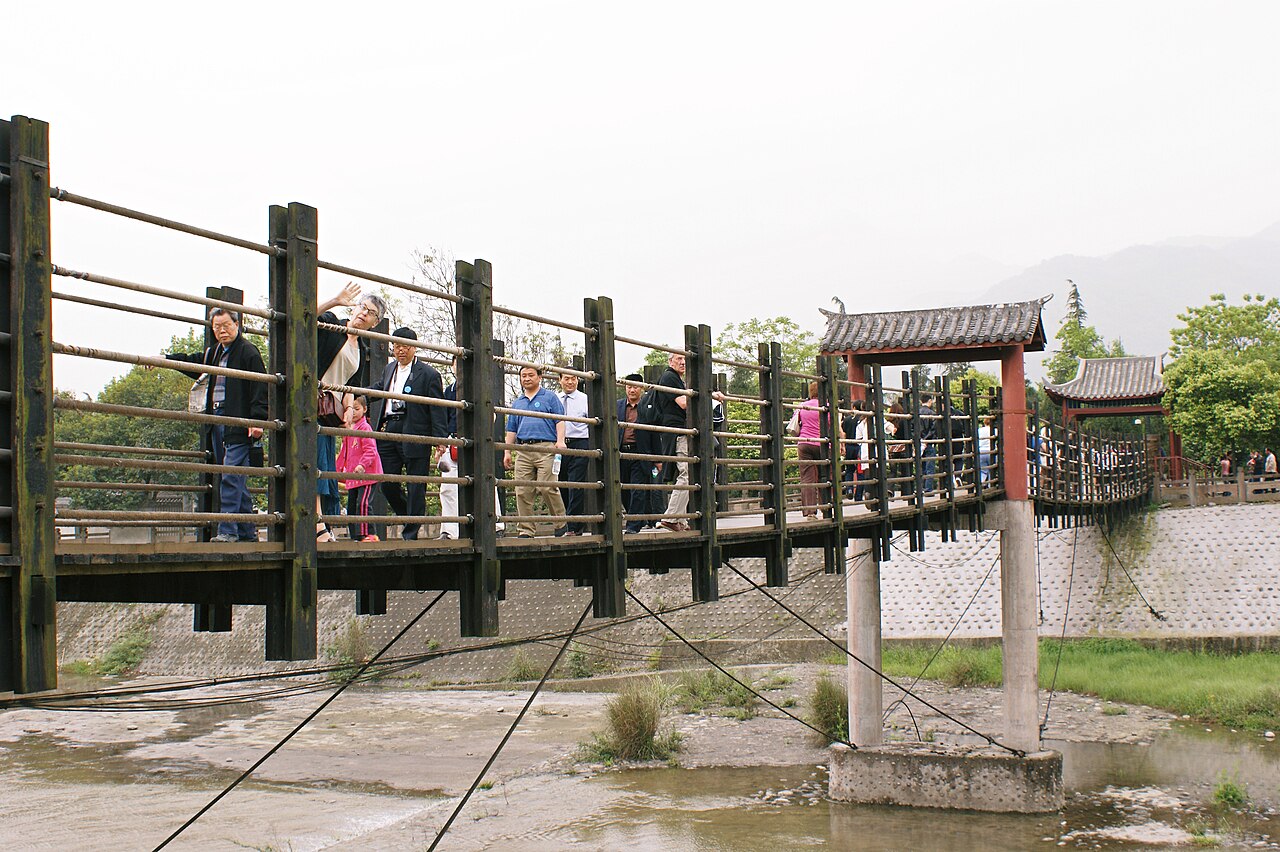
The back mountain is the opposite temperament: a wetter, wilder valley of streams, gorges and waterfalls, with the old town of Tai'an at its base and the Wulong ravine, the Baiyun caves and the multi-tier falls of Mount San Tan to be walked. Locals tend to prefer it, and it is where Chengdu families spend a slow weekend eating farmhouse food and breathing the famously humid, green air.
Whichever half you choose, the climate does the work. Qingcheng sits on the wet western rim of the Sichuan basin, mild and damp all year, with old trees, moss and running water everywhere. People come for the 'quiet' of the name, 'Green City under heaven's calm' — and in the temples, in the mist between the peaks, that quiet is still there.