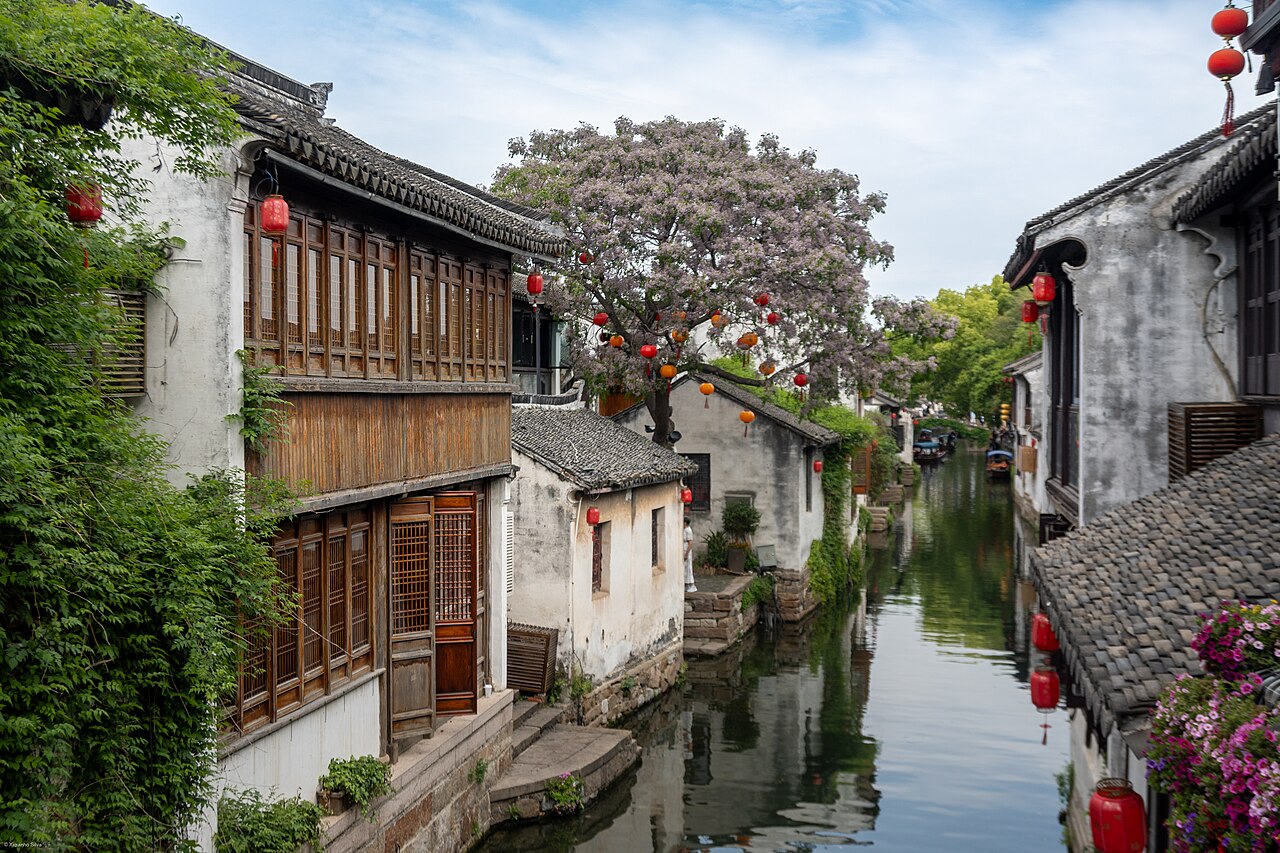
Fifteen canals cut Tongli into seven islets and forty-nine bridges stitch them back together. Every house stands on the water and every household keeps a boat; the Ming and Qing houses crowd the banks one after another; the bridges of the Song, Yuan, Ming and Qing are all still standing. It is the pattern the south is famous for, and it won the town its nickname, the little Venice of the east.
The old line about scenery is that it is three parts landscape and seven parts dressing-up. Tongli is the other way round — nine parts scenery, one part dressing-up. What you notice is not any single building but the accumulated weight of the place: you could grab a handful of the air and come away with a fistful of culture. Yu Qiuyu wrote in 'Cultural Travels' that walking into Tongli gives you the strange urge to find a room here and settle.
Its other advantage is that it has been developed less than its neighbours. Zhouzhuang and Wuzhen are now pure attractions; Tongli still works for a living. People are up at dawn and indoors at dusk, and the reward for respecting that rhythm is a town that still feels lived in rather than performed.
It is also the easiest of the water towns to reach from Suzhou — 18 km, a bus every 20 minutes, about 45 minutes — and it pairs naturally with Zhouzhuang an hour away. Stay one night if you can: the town empties after five, and on Friday, Saturday and Sunday evenings there is music by the three bridges.