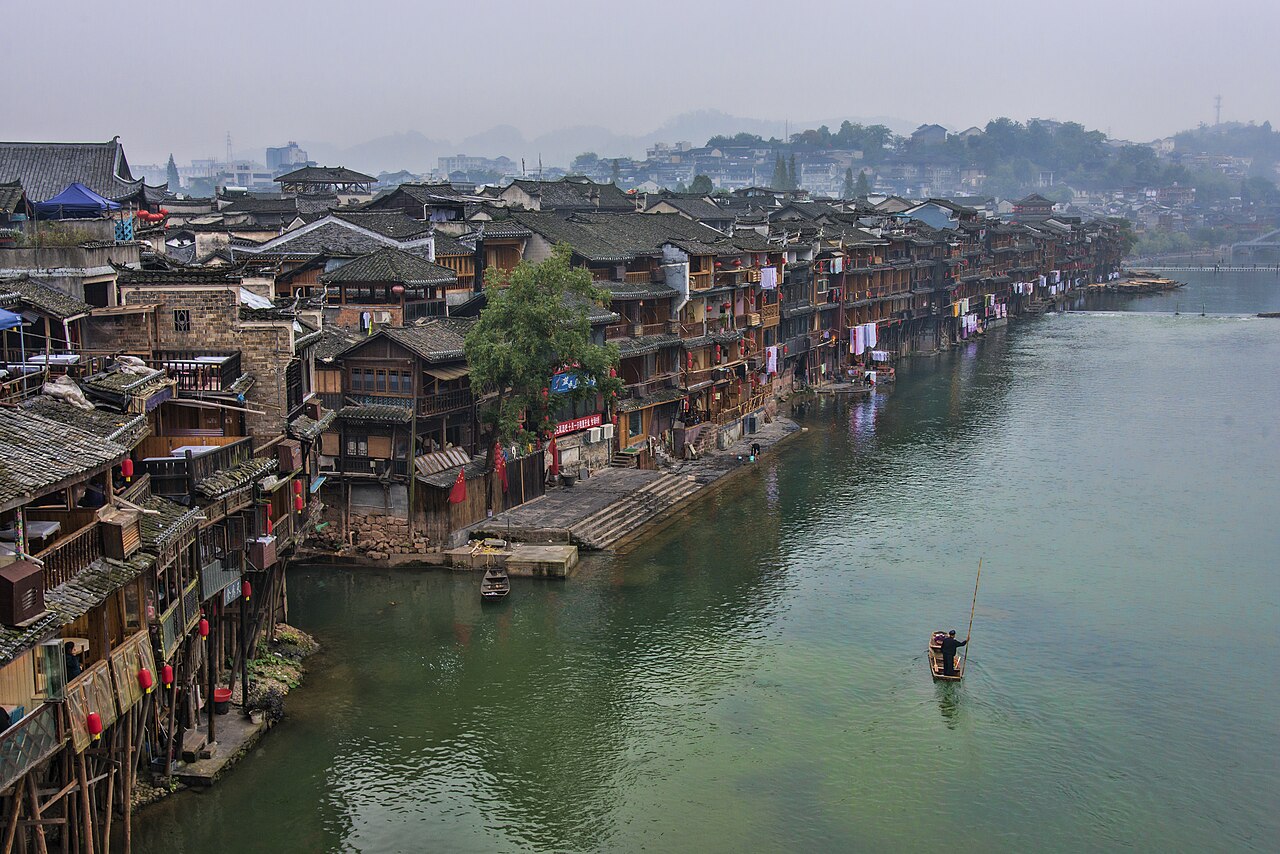
Zhenyuan is what happens when a river decides to draw a giant S through a 2,000-year-old town. The Wuyang River splits the old settlement in half — locals call the two banks the 'Wei City' and the 'Fu City' — and the green water reflects tile roofs, willow branches and the cliff-side temples of Qinglong Cave stacked above the eastern bank like something glued on. Come at dusk, when the lights come on and the reflection doubles the town, and you understand why people keep calling it a painting.
For most of its history Zhenyuan was not a tourist town but a fortress. It sat on the Southern Silk Road where the route from Hunan and Hubei pushed west toward Yunnan, Myanmar and India, and the phrase 'the key to Yunnan and Chu, the gateway to eastern Guizhou' was a military fact, not marketing. Armies of 28,000 once camped here, merchants from eight provinces built guild halls, and twelve opera stages ran at once. The lanes climbing the hillside — nicknamed 'crooked doors and slanted paths' — still follow that medieval logic.
What makes Zhenyuan worth the detour is that it has not been polished into a single street of souvenir shops. The old town is lived-in: grandmothers sell zongzi for CNY 1, the He Ping Cun POW camp museum is free and quietly devastating, and half an hour up the road are Dong villages where people still live in wooden ganlan houses. It is a place to slow down, walk, eat sour fish soup, and take the one-yuan ferry for no reason at all.